

American manufacturing serves as a cornerstone of the economy by driving innovation, supporting millions of jobs, and producing essential goods for people across the nation and the globe. The Manufacturing Institute reports that “the vast majority of Americans (8 in 10) continue to view U.S. manufacturing as vital to maintaining economic prosperity.” Unfortunately, not nearly as many Americans consider a career in manufacturing as lucrative and stable.
Some of the disconnect between knowing the value of manufacturing and choosing the industry as a career path stems from a lack of insight into the available career pathways. Northeast Advanced Manufacturing Consortium, in collaboration with AMTEP, offers a variety of manufacturing training programs that prepare young adults and adults looking to change careers across several manufacturing career pathways.
Let’s review some of the pathways that may complement your interests and special talents as you pursue a career that is right for you.
 CNC Machine Operator
 CNC Machine Operator
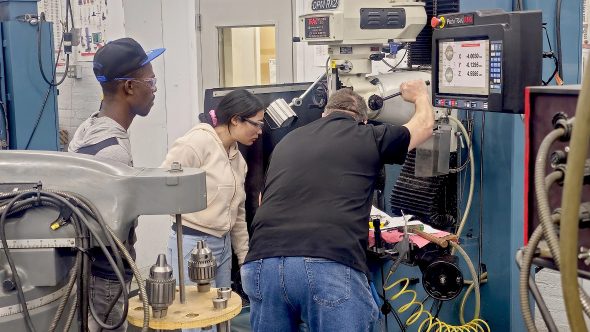
 A CNC machine operator sets up and operates computer numerical control machines in the metalworking industry. This role involves using computer programming to sculpt, cut, and finish component prototypes. While primarily in metalworking, these skills are also valuable in the automotive, hardware supply, and housing sectors. Key responsibilities include interpreting blueprints, inspecting parts for accuracy, and performing machine maintenance.
Learn more about an exciting career as a CNC Machine Operator.
Welding
If you enjoy hands-on work, welding may be the ideal career pathway for you. A welder uses intense heat and gas to join metal parts together or repair various faults in metal constructions. The day-to-day responsibilities of a welder include assembling metal parts while studying project specifications to select the best practices for each project.
Individuals who choose this field will use torches and arcs to weld various pieces of metal together, operate a wide range of welding equipment, analyze that equipment, and monitor welding processes, ensuring the heat doesn’t change the materials’ size and shape.
Learn more about careers in welding and the training opportunities available at NAMC and AMTEP.

Electronic Technician
An electronic technician tests, builds, and repairs electronic equipment. Individuals who choose this field can work in various industries, including engineering, broadcasting, and scientific research. Manufacturing technicians are involved in testing throughout final assembly, while those in engineering or scientific research install, maintain, and repair instruments for research and development. Electronic technicians focus on maintaining and repairing equipment, testing and monitoring systems, calibrating equipment, conducting quality control checks, preparing reports, and improving existing products.
Learn more about the training needed for this field and opportunities available through NAMC and AMTEP.
Electro-Mechanical Assembly
If you have always enjoyed taking things apart and putting them back together, a career in this field may be ideal for you. An electromechanical assembler constructs electromechanical equipment or devices.
Assemblers often operate, maintain, test, troubleshoot, and calibrate electronic equipment. Many day-to-day responsibilities include reading blueprints, interpreting instructions, ordering parts as needed, assembling parts, inspecting parts for imperfections, soldering electronic components, verifying that parts are the correct dimensions, and testing for mechanical reliability.
As an electromechanical assembler, an individual will use their knowledge of engineering drawings to create and assemble parts. Tools used include drill presses, portable power drills, wire strippers, crimpers, torque wrenches, and more.
Learn more about the programs that train assemblers at NAMC and AMTEP.
Quality Control
If you are a detail-oriented person, a career in the field of Quality Control may be right for you. A quality control inspector ensures that products and processes meet established quality standards and specifications. These individuals can work across various industries, evaluating, testing, and assessing potential defects and nonconformities in products, materials, and production processes. Those who pursue this career will have day-to-day responsibilities like inspection, documentation, sampling, collaboration, process improvement, reporting, root cause analysis, and training.
Find out more about this field and the training needed to become successful in Quality Control.

Robotics
Have you always wanted to work with robots? A robotics engineer helps create robotic systems that perform human and non-human duties. These individuals design, build, maintain, and repair robots while conducting research and developing new applications for existing robots. These robots are created for various purposes, from exploring planets to working in factories.
An individual who chooses this pathway will work across industries, including automotive and aerospace, as well as manufacturing, defense, and medicine. Some robotics engineers work on-site at manufacturing plants, while others might work off-site.
Find out more about the field of robotics and how you can access free training from the programs at NAMC and AMTEP.